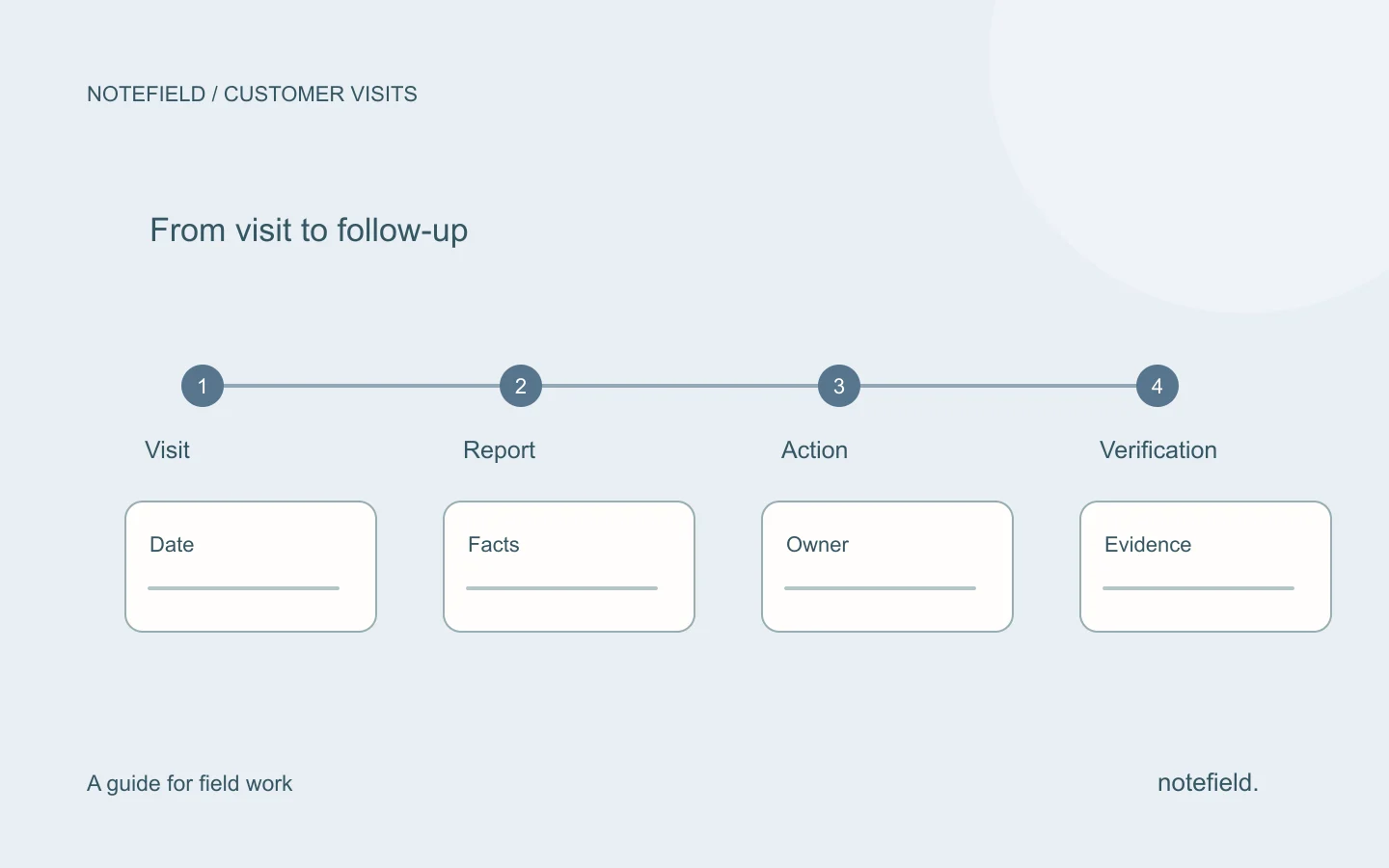
Field sales activity tracking should connect visits to their outcomes and next steps. Record the customer context, confirmed commitments, open questions and action owner rather than relying only on visit counts. A useful review distinguishes a completed visit from a progressed opportunity and a promised follow-up from an action actually completed.
The examples in this guide are fictional illustrations of a method, not notefield customer results.
For field teams, that question is harder than it looks. A visit may happen in a store, clinic, restaurant, distributor branch, factory, or customer office. The most useful details often appear outside a formal meeting: a buyer mentions a blocker while walking the site, a store manager explains why an order is delayed, or a regional contact gives a better next step than the one written in the CRM.
If that context is captured hours later, activity tracking becomes a weak record of calendar events. The CRM shows that a visit happened, but not whether the opportunity moved, whether the next step is real, or whether a manager should intervene.
The goal is not to monitor reps more closely. The goal is to reduce the manual work between a customer conversation and clean commercial data.
Which signals should a team track?
| Signal | Definition | Interpretation limit |
|---|---|---|
| Documented visit | A usable note is available | The presence of a note does not measure quality |
| Next action | Owner and deadline known | A proposal is not completion |
| Overdue action | Agreed date passed without closure evidence | Check agreed rescheduling |
| Unconfirmed information | Important field remains uncertain | Do not fill it by assumption |
| Open risk | Blocker linked to its source | Review relevance with the salesperson |
What field sales activity tracking should capture
Field sales activity tracking is not just a check-in, a GPS pin, or a completed task. Those signals prove presence, but they rarely explain commercial progress.
A useful activity record should capture five things after every important visit:
- The customer context: account, location, contacts present, and visit purpose.
- The outcome: what happened, what changed, and whether the visit achieved its goal.
- The next step: owner, deadline, promised action, and follow-up channel.
- The CRM impact: opportunity stage, close date, amount, task, note, or account-field changes.
- The manager signal: risk, blocker, missing stakeholder, competitor mention, or coaching opportunity.
That structure keeps the activity useful for three audiences. The rep gets less end-of-day admin. The manager gets visibility without chasing for context. Revenue operations gets cleaner data to trust in dashboards, forecasts, and handoffs.
Why traditional tracking breaks with field reps
Most field sales tracking fails because it starts from the wrong unit of work.
It treats the visit as an activity to log, not as a moment when account data changes. A rep can mark a meeting complete while still leaving the CRM unclear. The account note may say "good discussion", the opportunity stage may remain unchanged, and the promised follow-up may never become a task.
That creates four common failure modes.
First, the activity is too shallow. It shows where a rep went, but not what the customer agreed to do next.
Second, the update arrives late. Field reps move between appointments and often update CRM at the end of the day. By then, the exact objection, decision process, and next action are easier to blur.
Third, the record splits across tools. The visit sits in a calendar, the recap is in a note app, the follow-up is in email, and the CRM remains incomplete.
Fourth, managers compensate manually. They ask for updates in Slack, review pipeline calls with missing context, and turn one-to-ones into reconstruction sessions.
The better design is to treat each visit as a short capture workflow: prepare, meet, debrief, review, update, follow up.
A practical activity tracking workflow
The best activity tracking workflow is simple enough to use between appointments.
Before the visit, the rep should see a short brief: last interaction, open tasks, current opportunity state, known stakeholders, and questions to answer. A field sales meeting preparation checklist helps standardize that brief without turning preparation into another long form.
Right after the visit, the rep records or types a short recap while the details are fresh. The recap should cover what happened, what changed, what the customer promised, what the rep promised, and the next step.
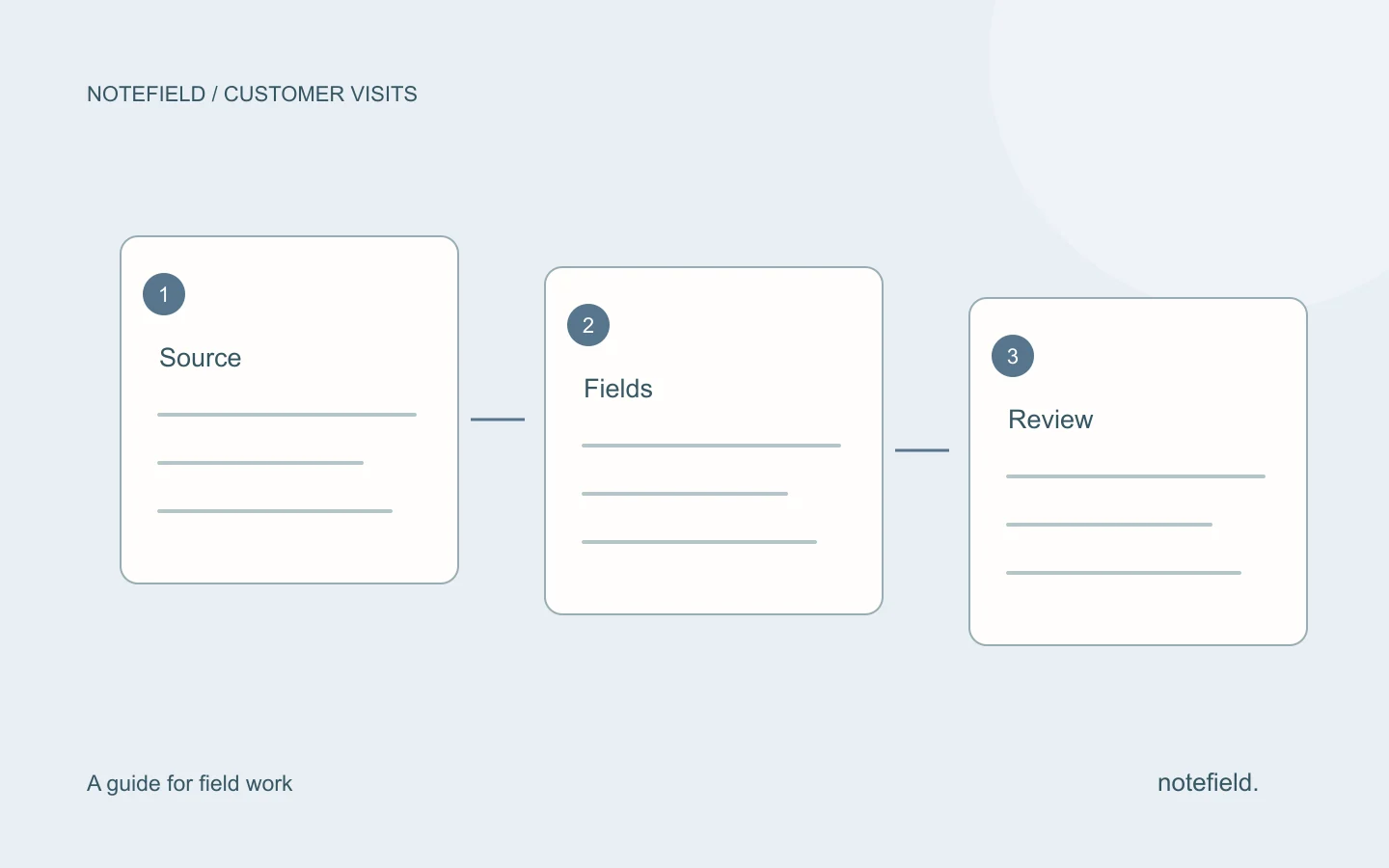
Then the system should turn that recap into reviewed outputs:
- A visit summary the rep can edit.
- Proposed CRM updates for fields, notes, tasks, and opportunities.
- A follow-up draft that reflects the actual conversation.
- A manager-visible exception when the deal needs attention.
This is where a voice-to-CRM workflow is useful. A rep should not need to open ten fields on a phone after a customer visit. They should be able to speak a concise debrief, review the structured result, and approve the update.
The review step matters. AI can structure a recap, but it should not silently turn uncertainty into fact. "The buyer seemed interested" is not the same as "The buyer confirmed budget." Good tracking preserves that distinction.
What managers should see
Managers do not need a live feed of every tiny action. They need a trustworthy view of exceptions and movement.
A field sales manager dashboard should answer questions like:
- Which visits created a real next step?
- Which opportunities changed stage, amount, close date, or risk?
- Which accounts have no follow-up task after a customer meeting?
- Which reps are stuck because of missing stakeholders or repeated objections?
- Which notes are too vague to support coaching or forecasting?
That is why activity tracking should connect to field sales manager visibility, not just personal productivity. The manager should be able to spot gaps before the forecast meeting, coach from recent visit context, and trust the pipeline because the important facts were captured close to the customer conversation.
This also improves data quality. A CRM is easier to trust when activity, notes, tasks, and opportunity fields tell the same story. If a visit uncovered a procurement blocker, that blocker should not live only in a paragraph nobody reads. It should become a risk signal, a next step, and, when appropriate, an opportunity update.
What not to track
Field sales activity tracking can become counterproductive when it tries to capture everything.
Avoid tracking that creates noise:
- Passive GPS trails with no commercial context.
- Mandatory long forms after every low-value touchpoint.
- Transcripts without structured next steps.
- Dashboards that reward activity volume instead of customer progress.
- AI summaries that update CRM without rep review.
The best system is selective. It captures meaningful customer interactions, proposes the right downstream updates, and makes the rep the reviewer before anything becomes official.
How to start without overbuilding
Start with one workflow: the post-visit debrief.
Pick the fields that matter most for your team: account, contacts, outcome, next step, date, opportunity change, risk, and follow-up. Use your existing field sales visit report template as the capture standard. Then define which parts should update CRM, which should create tasks, and which should alert a manager.
For the first month, measure adoption with practical signals:
- Percentage of customer visits with a same-day recap.
- Percentage of recaps with a clear next step.
- Percentage of follow-ups sent within 24 hours.
- Number of manager follow-up questions avoided.
- Number of CRM updates reviewed and approved by reps.
Those measures are more useful than counting raw activity volume. They show whether tracking is making the commercial record clearer.
How can notefield support this workflow?
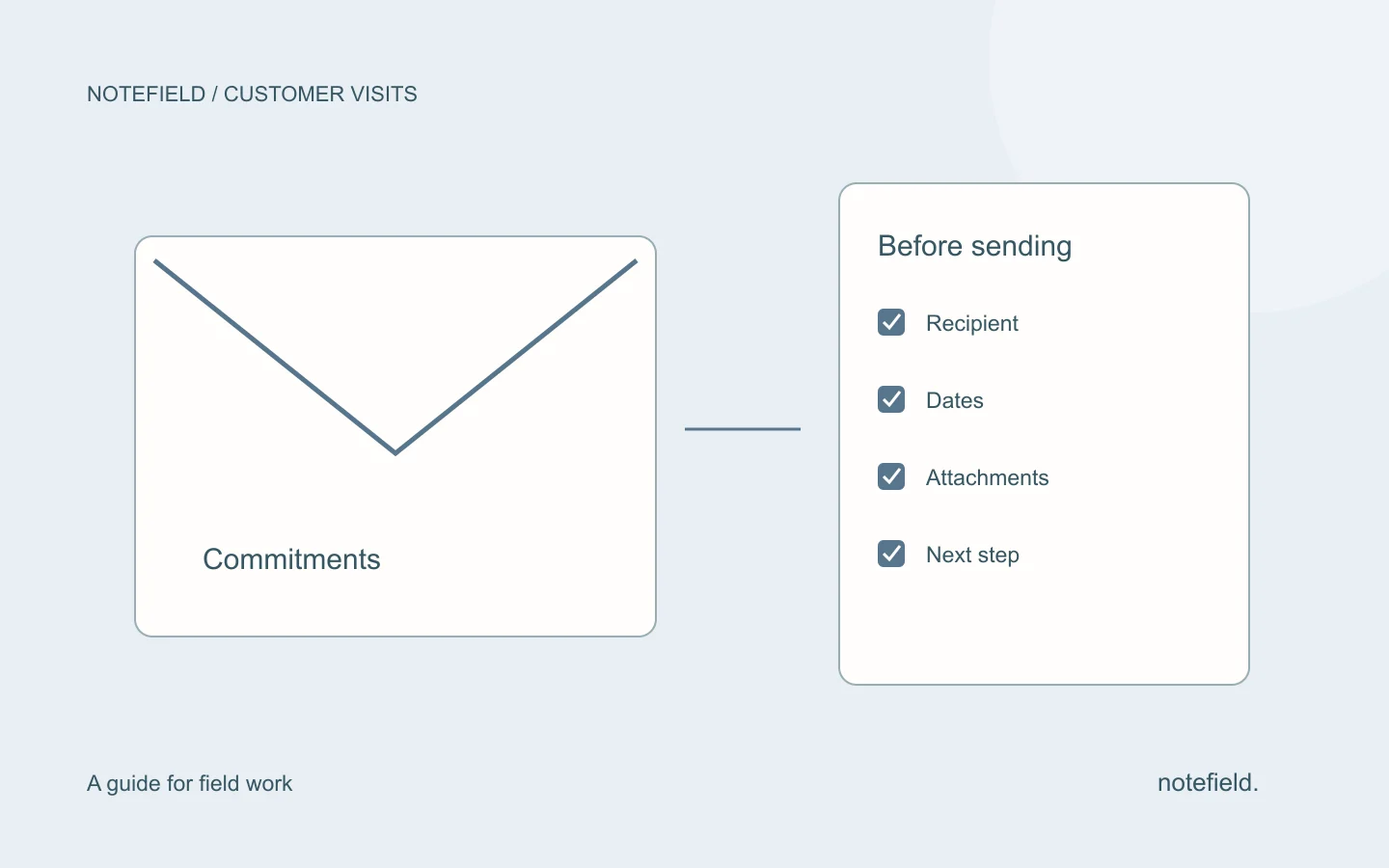
A reviewed notefield report can provide the context behind a visit and its next actions. The team still needs to confirm ownership, agree dates and check whether follow-up was completed; a generated action is not evidence of completion.
FAQ
What is field sales activity tracking?
Field sales activity tracking is the process of recording customer visits, outcomes, next steps, and CRM changes from field reps. The most useful systems track commercial progress, not just presence or completed tasks.
Should field sales teams use GPS tracking?
GPS can be useful for routing, territory coverage, or compliance, but it does not explain deal progress by itself. For sales management, customer outcome, next step, and CRM impact are usually more useful than location history.
How can AI help with field sales tracking?
AI can turn a short post-visit recap into a structured summary, proposed CRM updates, follow-up drafts, tasks, and manager alerts. The rep should still review and approve factual updates before they enter the CRM.
What is the best first workflow to automate?
Start with post-visit capture. It is close to the customer conversation, improves CRM quality quickly, and gives managers better visibility without asking reps to fill in longer forms.
How do visit records support more reliable pipeline data?
Tie a stage change to a fact confirmed during the visit. Distinguish expressed interest, a discussed budget and an actual commitment. During review, retain the open question and the source needed to verify it. Visit counts or fluent summaries do not by themselves prove that an opportunity has progressed.